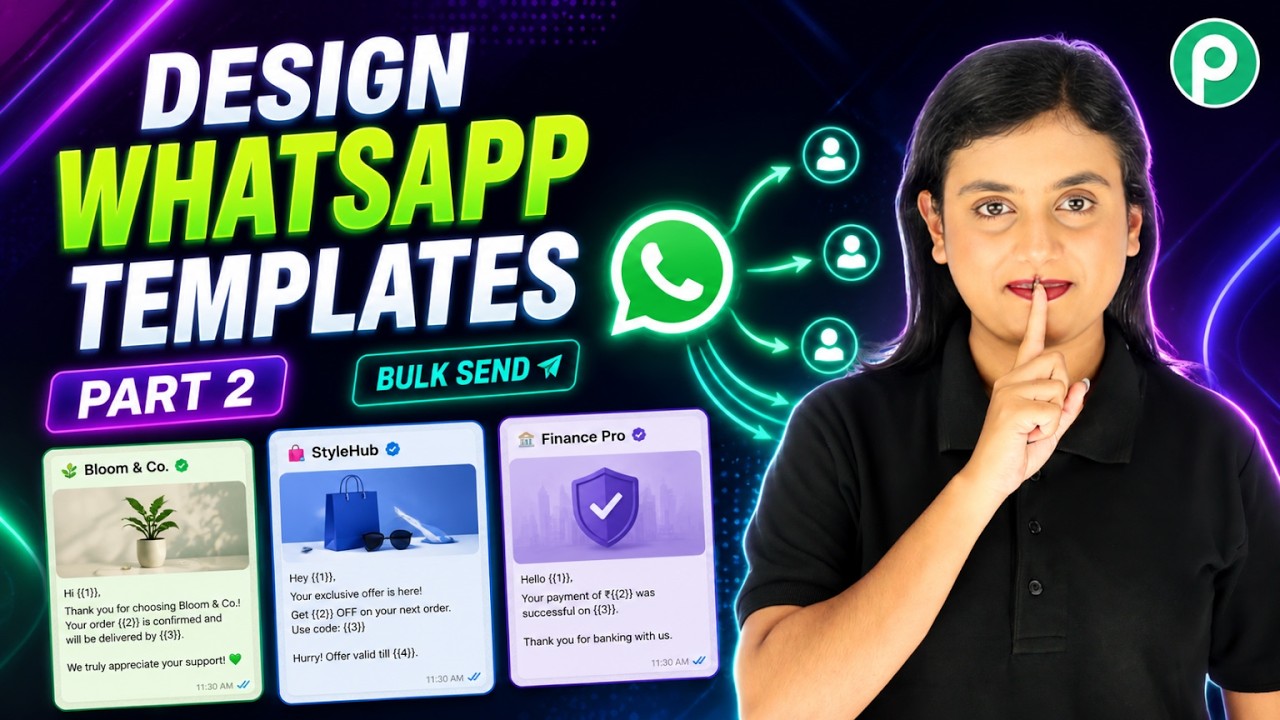
Watch Step By Step Video Tutorial Below
1. Creating a WhatsApp Template with Pabbly Chartflow
The first step in integrating For, So I, and WhatsApp involves creating a WhatsApp template using Pabbly Chartflow. This template will serve as your primary message format for broadcasting.
To start, open Pabbly Chartflow and navigate to the template creation section. Here, you can design your WhatsApp message by adding text, images, and buttons as per your branding needs. Make sure to save your template once you’re satisfied with the design.
2. Broadcasting Your Message to Customers
After creating your WhatsApp template, the next step is to broadcast this message to your customers using Pabbly Chartflow. This feature allows you to send bulk messages without getting your number blocked.
Follow these steps to set up your broadcast:
- Select the broadcast type as “Broadcast Campaign”.
- Name your broadcast, for example, “New Bulk Message Broadcast”.
- Choose a contact list from your Pabbly Chartflow account.
- Select the message type as your created template.
- Upload any necessary images from the media library.
After completing these steps, click on the “Done” button to finalize your broadcast setup.
3. Testing Your Broadcast Message
Before sending your broadcast to thousands of customers, it’s crucial to test it using Pabbly Chartflow. This ensures that your message appears correctly on WhatsApp.
To test your broadcast, enter your details, including your WhatsApp number, and send a test message. This will allow you to verify that everything looks good on the recipient’s end. If the test is successful, you can proceed to schedule or send your broadcast immediately.
4. Scheduling Your Broadcast for Later
Once you have tested your broadcast, you can choose to schedule it for a later time using Pabbly Chartflow. This feature is particularly useful for time-sensitive messages.
To schedule your broadcast, select the date and time you want your message to be sent. For example, if you plan to launch a sale, you can set the broadcast for a specific date and time. Make sure to confirm the scheduling settings before finalizing.
5. Conclusion: Automate Your WhatsApp Marketing
Integrating For, So I, and WhatsApp using Pabbly Chartflow allows you to automate your marketing efforts effectively. By creating templates and scheduling broadcasts, you can reach your audience efficiently.
With the steps outlined in this tutorial, you can take full advantage of Pabbly Chartflow to enhance your WhatsApp marketing strategy. Start engaging with your customers today!
PakarPBN
A Private Blog Network (PBN) is a collection of websites that are controlled by a single individual or organization and used primarily to build backlinks to a “money site” in order to influence its ranking in search engines such as Google. The core idea behind a PBN is based on the importance of backlinks in Google’s ranking algorithm. Since Google views backlinks as signals of authority and trust, some website owners attempt to artificially create these signals through a controlled network of sites.
In a typical PBN setup, the owner acquires expired or aged domains that already have existing authority, backlinks, and history. These domains are rebuilt with new content and hosted separately, often using different IP addresses, hosting providers, themes, and ownership details to make them appear unrelated. Within the content published on these sites, links are strategically placed that point to the main website the owner wants to rank higher. By doing this, the owner attempts to pass link equity (also known as “link juice”) from the PBN sites to the target website.
The purpose of a PBN is to give the impression that the target website is naturally earning links from multiple independent sources. If done effectively, this can temporarily improve keyword rankings, increase organic visibility, and drive more traffic from search results.